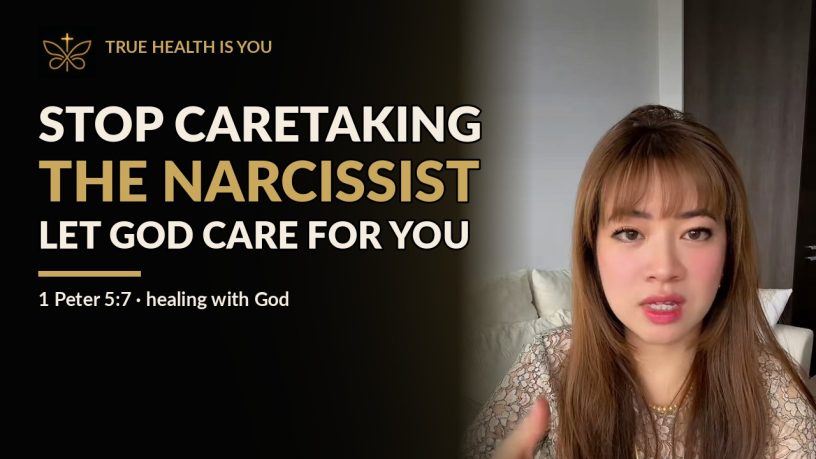


If you’ve spent your life caring for people who don’t care for you, especially a narcissistic person, you probably know the exhaustion I’m talking about. You give, you understand, you nurture, and you’re left empty. In Part 1, I shared why caretaking becomes a survival identity. Here, I want to share what has actually been healing it for me.
The word of the day is from First Peter, chapter five, verse seven:
“Cast all your care upon Him, for He careth for you.” 1 Peter 5:7
I was really meditating on this one, and I’ve actually been embodying and feeling the truth of it. I’m learning scripture right now in relation to healing trauma. So if you are a new follower, know that sometimes I’m going to bring in scripture and relate it to healing trauma. I feel this is important, especially in my journey right now.
No safe parents means no template for safe love
When we don’t grow up with safe parents, we don’t have a template for a safe, loving relationship. And this affects so many areas of our life.
But as the adult, as the conscious person that you are, we’re here to heal our inner child, to heal our inner person, and to look to a relationship that is safe and loving. That is the template. Everybody needs a template for a healthy, loving relationship, the kind we were meant to receive from a parent.
And so I am reparenting myself with Christ, with God.
I wasn’t always Christian
You might think, why? I want to explain this, because I wasn’t always Christian, and I didn’t always lean into this. Anybody who is a new follower finding me needs to know that. I don’t aim to push religion onto anybody. That’s not what I’m about.
But for me, it’s been deeply healing, because I believe we heal in relationship. We do. We get hurt in relationship. We heal in relationship.
What if you’ve only known unsafe relationships?
But what if the deepest part of you has only ever known an unsafe relationship, a toxic relationship?
If you grew up in a very toxic environment, an unsafe household, your foundation is off. And so you start trauma bonding and attracting codependent, narcissistic, abusive, complex, traumatic kinds of relationships, in friendships and in romantic relationships. All of it’s off.
So it’s like, okay: I’ve got to heal the deepest part of how I relate. How do I do that? By actually healing your relationship with yourself first, and God.
Why you need a healthy template
It’s so important that we choose a healthy template. We’re prone to being flawed. We’re prone to making mistakes. We’re prone to hurting each other. We’re just humans. Alone, we are just humans.
But in relationship with God, we have a template. We have a mirror. We have a relationship that is good, so we can know that we’re good. And that relationship gets transferred vertically. It influences how we relate, and we can be better with each other.
When we have a good relationship with ourselves and with God, we have a better relationship with each other.
If the word God is hard for you, use Love
If you want to use the word Love instead of God, because God is love, use Love, if that resonates with you more. If you have a better relationship with Love as your template, you are going to love better. And Love, God, will give you the truth.
So many people have been hurt by wounded people projecting their trauma onto faith. If that’s you, you don’t have to force a word that hurts. Start with Love.
The Word has to be felt, not only known
“Cast all your care upon Him, for He cares for you.” It’s a really good word. But for me, I have to feel it. It has to be integrated in my heart. Until that translation happens and it’s embodied, until you know the Word in your heart, things won’t change.
I’ve seen this with Christians who tell me, “I know the Word, but I don’t feel it.” It’s because we have a lot of trauma blocking that. So this work I do is understanding it at the heart level, because real changes in your life happen when we understand it at the heart level.
For me, that has definitely been the case: to be more grounded in my nervous system, and to know this relationship, this divine relationship, in my heart.
How I got there: grieving
How I got there is grieving. How I got through pretty much anything is grieving.
I grieved my attachment to how I care for others. Because in a traumatic home, you learn to care for others who are unsafe and who don’t really care for you. And when you grow up in such an unsafe, unstable, traumatic environment, you actually need that care so much that oftentimes we project how much care we need onto others.
I cared for others so much because I was hoping, deep down somewhere, that I would get that care back from them someday. I was hopeful for it. But I realized something.
Care exists within you
Care exists within you. You are the source of the love, the care, the safety. You are the source. God is the source within you.
It’s really about clearing those traumas for you to access that. How beautiful is it that it’s already within you, and you only have to access it? You do this by clearing the pathway.
How beautiful is it that you don’t have to outsource the very root and foundation of your love and care and safety? It’s added onto you when you know it’s in here.
Seek first the kingdom of heaven, and it will be added unto you. In this context, the care will be added unto you. But first, find it within your heart.
From worldly caretaking to receiving care from God
I found that through grieving my caretaking: my feelings toward my primary attachments, the deep attachments in my life, how much I cared for them and how they didn’t care for me back.
And then, when those core attachments were grieved through, I realized: wait, I’m cared for. That verse finally made sense to me. When I grieved all the care, I could cast all the care upon Him, for He cares for me.
That’s what happened through grief and detachment: I moved from caring in a worldly way to receiving care from God.
Gentle first steps if you’re struggling with caretaking
- Notice the urge. When you feel pulled to caretake someone who doesn’t care for you, pause and name it.
- Feel what’s underneath. Often it’s fear that something bad will happen, or grief for the care you never received.
- Let yourself grieve. Grieve the care you gave that never came back, in your body and heart both.
- Cast it upon Him. Pray 1 Peter 5:7, or simply say, “I give this care to God/Love. I am cared for.”
- Practise receiving. Notice small moments where care comes to you, and let them in.
So if you’re struggling with caretaking, this is what you do. You grieve, you return to the source within you, and you let yourself be cared for.
If you haven’t yet, watch Part 1: Caretaker Addiction, Why Empaths Always Care for Narcissists. And if you’re ready for support, you don’t have to do this alone.
- Without safe parents, we don’t have a template for safe, loving relationship.
- We get hurt in relationship, and we heal in relationship, starting with ourselves and God.
- If the word God is hard for you, start with Love.
- The Word has to be felt in the heart, not only known.
- Care exists within you; grieving your caretaking lets you receive care from God.
Continue with Part 1: Caretaker Addiction: Why Empaths Always Care for Narcissists.
Frequently Asked Questions
How do I stop caretaking a narcissist?
Start by seeing that caretaking is a survival pattern, not love that will finally be returned. Grieve the care you gave that wasn’t received, and learn to receive care from God/Love and from within yourself, so you’re no longer outsourcing your safety.
What does 1 Peter 5:7 mean for healing caretaking?
“Cast all your care upon Him, for He careth for you” invites you to give God the caretaking urges and feelings you’ve carried, and to receive care instead of only giving it.
Why do I need a template for a healthy relationship?
Without safe parents, we don’t learn what safe, loving relationship feels like. A relationship with God, or with Love, gives a healthy template that transfers into how we relate to ourselves and others.
What if the word God is triggering for me?
Use the word Love. God is love, and a better relationship with Love as your template helps you love better.
If you are healing from caretaking and narcissistic abuse and want support, learn about working with a narcissistic abuse therapist Toronto empaths trust, or about faith-based Christian counselling Toronto (online across Ontario).
If you’re tired of caring for people who don’t care for you, you don’t have to grieve it alone. I help empaths heal caretaking and trauma bonds with God at the centre.
Book a free consult or 60-minute session
Can’t find a time that works, or want to reach Tracey directly? Send a message or email truehealthcounselling@gmail.com.
🦋 Body to Business Portal: you are the medicine, healing yourself is the business. · ✝️ Christian counselling for faith-based trauma healing. · 🎧 Listen on Apple Podcasts.
Educational only. Not a substitute for individual therapy or medical care.