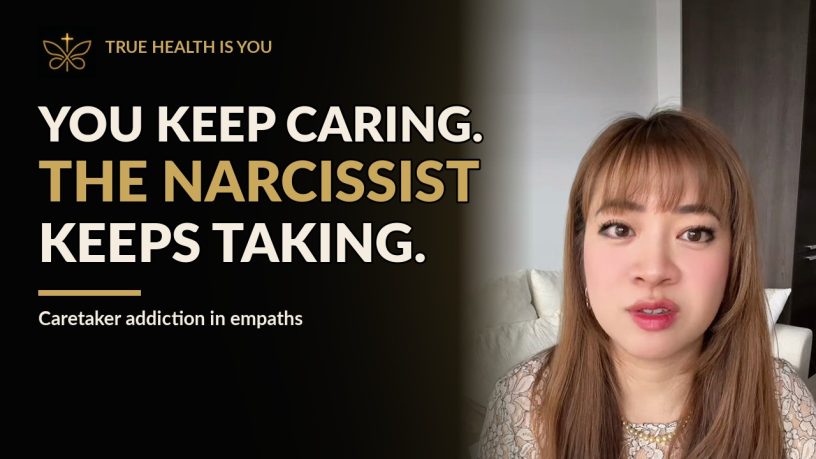



I’m talking to the empath who cares too much.
You have always been the person who gives your heart and cares so much in relationships, especially with a narcissistic person. You notice what they need before they say it. You soften your voice so they won’t get upset. You give and give and give. And somewhere deep down, you are exhausted.
Let me ask you gently: what do you think that is doing to you long term?
I didn’t think about this for a long time. I thought that if I cared and cared and cared a lot for this person, someday they would care about me too. If you have ever believed that, this is for you. You are not foolish, and you are not weak. You learned to love this way for a reason, and that reason can heal.
Their actual capacity versus your hope
Here is the truth I had to face. It’s not that the narcissistic person doesn’t want to care for you. It’s that they don’t have the capacity. And I failed to see that they didn’t have the capacity for a very long time.
So it’s important to see somebody’s actual capacity versus your hope of what they could do. Empaths are beautiful at seeing potential. We can see the wounded child inside someone, the person they could become, the love they might one day be able to give. But potential is not capacity. When you build your whole heart around who someone could be, you keep pouring into a vessel that cannot hold it.
Seeing someone’s actual capacity isn’t cold. It’s honest. And honesty is where your healing begins.
Where the caretaker wound starts
That wounding runs really deep. Let’s say your father was a very narcissistic person, and you always wanted to feel emotionally seen, heard, understood and cared for by him. And you weren’t. In fact, you experienced quite the opposite. You were hurt by this person.
So of course, naturally, you want to experience care and love and safety, because you were so deprived of that growing up and throughout your life.
And so if you’ve developed into this super nurturing person, the caretaker in your relationship, and you’re exhausted, and it feels one sided, it’s not by accident.
Caretaking is a survival identity
This is a survival identity that you have developed over time with narcissistic abuse.
You learned to be the caretaker of their emotions. You learned to be the caretaker to them so they wouldn’t get upset, so there was some level of peace between you. Because they were so devoid of emotional care toward you, so focused on themselves, you learned over time: this is how relationship is.
You learned: I just have to pour my care onto him, like a caretaker, like a person who’s super nurturing. And what he might give back to you is very basic. Sometimes not even a basic level of attention, only sometimes. In some of these dynamics he might give financial support. Sometimes he doesn’t even give that, only a little attention.
And because you’ve been deprived of that care and love and safety, and so deeply neglected for so long, that deep need in you is going to attract these kinds of relationships. Relationships where you’re the one who is always caring for them, and they’re not really emotionally caring for you.
Let’s get real here. They’re not seeing you, hearing you, or understanding your deepest needs for care.
Signs you’ve become the caretaker in a narcissistic relationship
- You manage their moods so they won’t get upset, and call it keeping the peace.
- You feel responsible for their feelings, but your own feelings rarely get asked about.
- You feel exhausted, and the relationship feels one sided.
- You keep hoping that if you care enough, they’ll finally care for you back.
- When you try to stop caretaking, you feel fear, guilt or a sense that something bad will happen.
- The crumbs of attention you receive feel like a lot, because you’re so hungry for care.
If you see yourself here, please hear this with kindness: this isn’t a character flaw. It’s a nervous system that learned to survive by caring for the person who was hurting it.
They are not responsible for your deepest needs
In fact, they’re not responsible for those deep, deep needs for care. As an adult now, it’s our job to deeply meet those needs.
But naturally, we learn in relationship. And when we’ve been so hurt by a relationship, we only know how to function in this kind of caretaker relationship. The way to really heal that is to have a template of a healthy relationship.
But what if you have never had a healthy relationship? What if you always had the narcissistic, abusive type of relationship? What if all you ever attracted were narcissists, and you were the nurturer, the caretaker, the understanding one, and they gave you scraps? A little attention. Very basic. You know he doesn’t really, deeply care for you.
So what do you do?
How I have healed (and am still healing)
This is how I have healed, and I’m still healing, because that wounding in me was rather large. But I feel like I’ve gotten to that foundation where it finally hit my heart: I am cared for.
Someone can simply say to you, “You are cared for.” You might not believe it until you feel it in your heart, in relationship.
I have been learning this through my relationship with God. I’m learning scripture now, throughout this journey of Christianity, and the verse I want to give you is from First Peter, chapter five, verse seven:
“Casting all your care upon Him, for He careth for you.” 1 Peter 5:7
Basically that means: give Him all your care. All this caretaking. All the caretaking feelings you have, the urge to caretake. Give Him all of it. And He cares for you.
Caretaker addiction and the pain underneath
As I was grieving through this care, I noticed that care is like an emotion you can feel. And there’s a type of suffering that comes from it.
When it was really bad before, I had caretaking addiction with a narcissistic person, and I felt a lot of pain underneath that. As I was healing caretaker addiction, there were stages I had to go through. As a compulsive caretaker, actually resisting caretaking brought up such crazy pain in me. It was like the addiction recovery process. What came up was this fear: if I don’t care for this person, if I don’t do this, something bad is going to happen.
That’s what happens when you grow up in a really unsafe environment and you have been groomed and conditioned to take care of someone so unsafe towards you. Later on, you turn into an adult who becomes super nurturing, caretaking and caring, and you feel hurt because you’re not getting that level of care back.
Why? Because you grew up in this kind of environment. You were groomed and conditioned. It’s so deeply hardwired into your system to survive by taking care of the one who is deeply hurting you. That’s an intense trauma bond. It’s so painful to care for this person, but that is the only way this relationship exists.
Grieve the care, and remember who cares for you
To heal this, you have to grieve all of this care. Grieve the care you gave that never came back. Grieve the hope you placed in someone who didn’t have the capacity. Let the pain move through your body and heart, instead of pushing it down by caretaking even harder.
And remember who cares for you. God cares for you.
Cast all your cares upon Him, for He careth for you.
You were never meant to carry everyone. You were meant to be held, too.
If this is your story and you don’t want to untangle it alone, you’re welcome to reach out. And if you want to go deeper, watch Part 2, where I share how God healed my caretaking.
- Caretaking is a survival identity, not a personality flaw.
- See someone’s actual capacity, not your hope of what they could give.
- As an adult, meeting your deepest needs for care is your job, not theirs.
- Stopping caretaking can feel like withdrawal; the fear underneath is real, and it can heal.
- Grieve the care you gave that never came back, and remember: God cares for you (1 Peter 5:7).
Continue with Part 2: How to Stop Caretaking a Narcissist: Let God Care for You.
Frequently Asked Questions
What is caretaker addiction?
Caretaker addiction is a compulsive pattern of caring for others, often an unsafe or narcissistic partner, that develops as a survival identity in an unsafe environment. Resisting the urge to caretake can bring up intense fear and pain, much like addiction recovery.
Why do empaths become caretakers for narcissists?
Empaths who were deprived of care, love and safety growing up often learn to caretake other people’s emotions to keep the peace. That deep unmet need for care tends to attract one-sided relationships with people who don’t have the capacity to care back.
Is the narcissist responsible for meeting my needs?
No. As adults, it’s our job to meet our deepest needs for care. Seeing someone’s actual capacity, rather than your hope of what they could give, helps you stop pouring into a relationship that can’t hold it.
How do you heal caretaking?
By grieving the care you gave that wasn’t returned, letting the fear and pain move through your body, and learning to receive care. For Tracey, that happened through her relationship with God and 1 Peter 5:7: “Cast all your care upon Him, for He careth for you.”
If you are healing from caretaking and narcissistic abuse and want support, learn about working with a narcissistic abuse therapist Toronto empaths trust, or about faith-based Christian counselling Toronto (online across Ontario).
If you’ve always been the one who cares for everyone, and you’re exhausted, you don’t have to untangle caretaker addiction alone. I help empaths heal from narcissistic abuse with faith at the centre.
Book a free consult or 60-minute session
Can’t find a time that works, or want to reach Tracey directly? Send a message or email truehealthcounselling@gmail.com.
🦋 Body to Business Portal: you are the medicine, healing yourself is the business. · ✝️ Christian counselling for faith-based trauma healing. · 🎧 Listen on Apple Podcasts.
Educational only. Not a substitute for individual therapy or medical care.